Dachshund
 Germany
Breed Traits
About
A Dachshund is a big dog in a small body. It is affectionate and often deeply attached to one favourite person, yet independent enough to ignore you when something more interesting catches its nose. Expect a busy, curious companion that loves burrowing under blankets, digging in plant pots and announcing every visitor with a surprisingly deep bark. Dachshunds adapt well to apartment life, but they still need daily walks and play. Their courage is admirable, though it means they may challenge much larger dogs without hesitation.

Is the Dachshund Right for You?
Ideal Home / Owner
A Dachshund suits a home where someone is around for much of the day, ideally with few stairs and adults or older children who handle it gently. It is not ideal for families with very young kids who may drop it, or for owners who want a dog that is easy to house train.
Dachshund History
The Dachshund is a German breed whose name simply means badger dog, from dachs (badger) and hund (dog). Short-legged hunting dogs existed in Germany for centuries, but the breed as we know it took shape during the 1700s and 1800s. German foresters and hunters wanted a dog that could track scent above ground and then follow badgers, foxes and rabbits into their burrows.
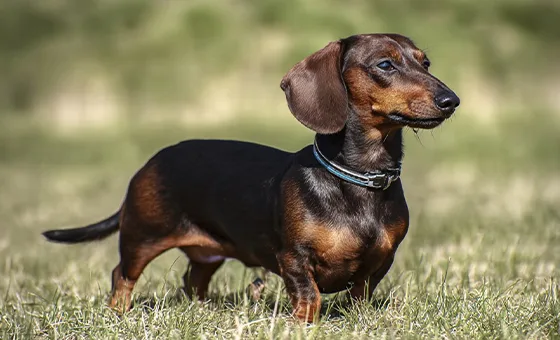
Every part of the Dachshund was designed for that work. Its short, strong legs and paddle-like front paws helped it dig, its deep chest gave it lung capacity underground, and its loud bark let hunters locate it below the earth. Larger Dachshunds were used on badgers and in packs on wild boar, while smaller dogs were kept for rabbits. Three coat types developed over time: smooth, longhaired and wirehaired.
The breed became a national symbol of Germany and was a favourite of European royalty, including Queen Victoria. Its strong German association caused its popularity to fall in Britain and America during both World Wars, when it was briefly renamed in some places. It recovered quickly afterwards, and in 1972 a colourful Dachshund called Waldi became the first official Olympic mascot at the Munich Games.
Today the Dachshund is one of the world's best-known companion breeds, kept far more often on sofas than in burrows. It comes in standard and miniature sizes, and in Germany it is still used by some hunters for tracking. In India, Dachshunds are a familiar sight in city homes, valued for their compact size, entertaining nature and alert watchdog bark.
Diet
Weight control is the single most important part of feeding a Dachshund. Even one or two extra kilograms puts serious strain on its long spine and raises the risk of disc disease. Choose a complete, good-quality small or medium-breed diet suited to your dog's size and life stage, and measure every meal rather than free feeding. Dachshunds are skilled beggars, so keep treats and table scraps to a minimum. You should be able to feel the ribs and see a waist from above. Ask your vet for exact portions.
Weather & climate
Bold and Spirited
A fearless little hound with a loud bark and big personality that loves its family and stands its ground.
Training
Dachshunds are clever but were bred to make decisions on their own underground, so they can be stubborn. Keep training sessions short, upbeat and full of rewards, and stay patient and consistent. House training can take longer than with many breeds, especially during monsoon when they dislike going out in the rain. Early socialisation helps prevent wariness of strangers and excessive barking. Teach your Dachshund to use ramps or steps rather than jumping off furniture.
Grooming
Grooming depends on the coat type. Smooth Dachshunds need only a weekly wipe or brush. Longhaired dogs need brushing two or three times a week, paying attention to the ears, chest and legs where tangles form. Wirehaired dogs need regular brushing and occasional hand-stripping or trimming by a groomer. All types need nail trims, dental care and ear checks. Their long ears can trap moisture, so clean and dry them after baths and during humid weather.

Health
Intervertebral disc disease is the major health risk in Dachshunds, and it can cause pain, weakness or paralysis. Prevent it by keeping your dog lean, limiting jumps and stairs, and lifting it with support under the chest and hindquarters. The breed can also suffer from dental disease, obesity, eye conditions such as progressive retinal atrophy, and skin problems. In Indian summers, Dachshunds sit close to hot pavements, so walk them in the early morning or evening and test the ground with your hand first.